DevLink – IT Recruitment Platform
An IT recruitment platform connecting candidates and employers, featuring AI-assisted resume matching, career guidance, and automated job aggregation from external sources.
Overview
DevLink is a recruitment platform for the IT industry in Vietnam. It brings the workflows of a job marketplace into one NestJS backend: accounts, companies, job postings, applications, online CVs, AI-assisted CV analysis, a career chatbot, notifications, and statistics.
| User | Main tasks |
|---|---|
| Candidate | Search jobs, build and export CVs as PDF, apply, save jobs, follow companies, ask the career chatbot |
| Recruiter (HR) | Manage companies and job postings, track applications, view statistics |
| Administrator | Approve postings, manage users, companies, and applications across the system |
My Role
This is a personal project where I worked as a Fullstack Developer with a backend focus:
- Designed background queues with BullMQ and Redis for CV analysis, email, and job synchronization.
- Built a job aggregation system with a dedicated adapter per source.
- Designed the scoring algorithm that matches CVs against job postings.
- Implemented JWT authentication with refresh token rotation and authorization with CASL.
- Built the Next.js interface for candidates, HR, and administrators.
Problem & Solution
| Problem | Solution |
|---|---|
| AI CV analysis is slow and depends on provider quotas, so it cannot run inside the application request | Run it on BullMQ in two steps, parse and analyze, with retries and rescheduling when quota runs out |
| Jobs are scattered across platforms with different formats | Give each source its own adapter and normalize results into one shared structure |
| AI-generated scores are hard to explain and hard to reproduce | AI only turns CVs into structured data. The match score comes from a fixed formula in the backend |
| External postings may close but stay visible | Manage each posting through ACTIVE, STALE, and CLOSED states with scheduled synchronization |
System Architecture
Architecture Blueprint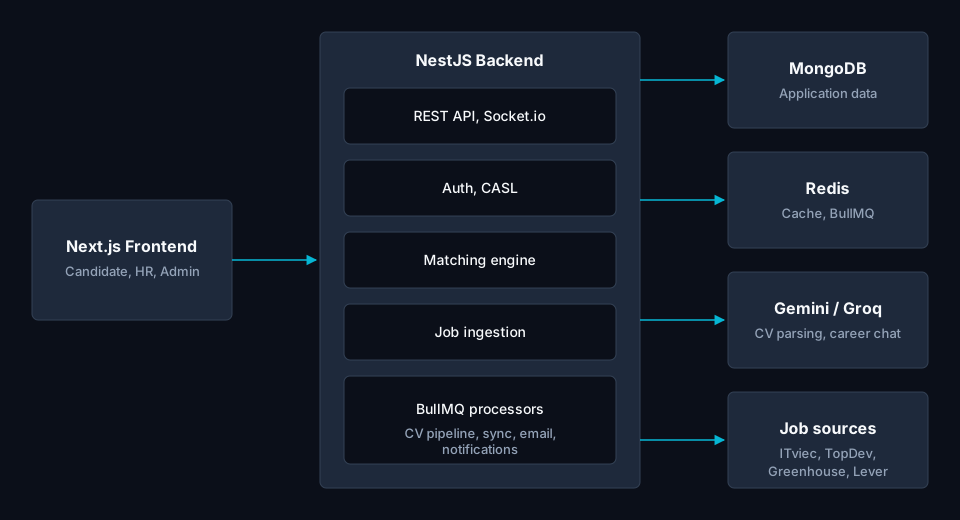 DevLink architecture diagram: the Next.js frontend calls the NestJS backend. The backend stores data in MongoDB, uses Redis for caching and BullMQ, calls Gemini and Groq, and collects jobs from ITviec, TopDev, Greenhouse, and Lever.
- Frontend (Next.js): organized by feature, calls the API through RTK Query, and separates the candidate, HR, and admin areas.
- Backend (NestJS): a single application split into business modules. Business rules live here, not in AI prompts.
- MongoDB: stores business data, external job postings, and sync history.
- Redis: caches dashboard and API data, backs BullMQ, and counts Gemini quota.
- BullMQ: 7 queues for CV processing, email, notifications, job synchronization, and account deletion.
Tech Stack
Key Features
AI CV Matching
When a candidate applies, the request returns immediately and analysis runs in the background:
- Text is extracted from PDF, DOC, DOCX, or TXT files.
- Gemini converts the CV content into structured JSON.
- An
analyze-resumejob is queued, with up to 3 attempts and exponential backoff. - The backend calculates a weighted score: skills 50%, experience 30%, education 20%.
Skills are normalized through an alias table before matching. Experience is compared with the year range of each job level, from Intern to Manager.
Crawl & Aggregate IT Jobs
The system syncs jobs from ITviec, TopDev, Greenhouse, and Lever every 6 hours:
- Each source adapter fetches listings and details. ITviec and TopDev go through sitemaps, while Greenhouse and Lever use board data.
- Filters reject postings with missing required fields, non-IT postings, and postings outside Vietnam that are not remote.
- Valid postings are normalized into one structure and written with a
bulkWriteupsert. A unique index onsourceKeyandexternalIdprevents duplicates within a source. - Posting lifecycles are updated from the sync result.
A posting missing from a complete listing moves to STALE and stays visible for a 5-hour grace period before moving to CLOSED. For sources set to LINK_ONLY, the system still extracts skills but does not store the job description.
Technical Challenges
Keeping the pipeline running when AI quota runs out
Gemini limits requests, and several workflows share the same quota. The system counts quota in Redis per minute and per day, and reserves a share for each kind of work. When a CV parse job is denied for quota, it is rescheduled instead of failing. The chatbot uses Groq by default and can fall back to Gemini on eligible Groq errors.
Not closing postings when a source returns a partial list
One failed crawl can make many postings look as if they disappeared. If a listing is empty, or shrinks below 50% of its previous size for sources with at least 20 postings, the sync is marked SUSPECT. That listing is not treated as complete, so it does not mark postings as gone, and the system logs an alert.
Avoiding duplicate sync runs
Cron and manual triggers can target the same source. Both use the same jobId, so BullMQ ignores the duplicate job. Sync jobs have up to 3 attempts with exponential backoff.
Screenshots
Candidate
Administration
Results & Lessons
The project completes the main workflows for candidates, HR, and administrators, and keeps jobs from 4 external sources up to date automatically. It has no production usage data yet, so this section reports no performance metrics.
- AI belongs at the edge of the system. When AI only handles extraction, business decisions stay testable and explainable.
- Third-party data should not be trusted by default. Size limits, timeouts, filters, and the
SUSPECTstate all come from this idea.
Next improvement: sync alerts currently go to logs only. The next step is sending them to Slack or email.
Related projects
Ecochic - Internal Business Management Platform
Internal enterprise platform supporting HRM, financial management, and digital signing workflows, built with a microservices-oriented architecture.
NestJSFastifyPostgreSQL+12Laptop Shop - E-commerce REST API and Storefront
A decoupled e-commerce platform: a REST API serving a Next.js storefront and admin dashboard, covering catalog search, cart, idempotent checkout, bank-transfer payments, flash sales, reviews and after-sales.
Node.jsExpress 5TypeScript+14